 Samvinas Help
The four stages of Creative Problem Solving
CPS moves through four stages — Clarify, Ideate, Develop, Implement — and inside each one the diverge–converge heartbeat runs at least once. Groups rarely march through the stages in a straight line, and they don't need to; the practical skill is knowing which stage the work is in.
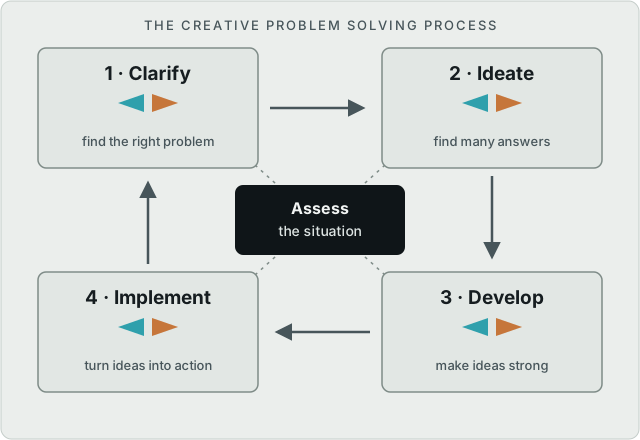
The centre: assess the situation
The hub of the model isn't a stage — it's a habit. Assessing the situation means pausing to take stock: what do we know, what do we have, and which stage does the work need next? It's the move a group returns to between stages, and it's why the process is drawn as a cycle around a centre rather than a straight line. A group might assess and realise it needs to go back to Clarify — or that it can skip straight to Develop, because good ideas already exist. The process at a glance gives a starting condition for every step; use it to decide where to enter.
1. Clarify — find the right problem
Clarify is the biggest stage — big enough that it breaks into three steps of its own, each with the heartbeat inside it:
- Frame the goal. Diverge on wishes — "I wish…", "It would be great if…" — and converge on a challenge the group cares about, can act on, and that genuinely needs new thinking.
- Gather data. Explore the territory: what's known, what's been tried, who's involved, what ideal would look like. Keep the findings that change how you see the challenge.
- Find the problem. Turn what you learned into candidate questions and converge on the one worth solving: a well-formed "How might we…?" question.
Done looks like: a question the group agrees is the real one. Samvinas tools: Five Whys, Word Cloud, a Brainstorm of questions.
2. Ideate — find many answers
With the question clarified, generate options against it — wide, plentiful, judgement deferred — and then converge on the promising few. Done looks like: a shortlist the group is genuinely curious about. Samvinas tools: the generating tools, then Voting or Ranking.
3. Develop — make the chosen ideas strong
Take the shortlist and strengthen it: name what is good, surface concerns as questions, and answer them. This is the stage where a fragile idea becomes a workable one. Done looks like: ideas with their major concerns overcome — or consciously retired. Samvinas tools: PPCO and its ALoU / LCO / PMI relatives, Evaluation Matrix.
4. Implement — turn ideas into action
Finally, work out the path: what happens first, who does what, and what the world will need before it accepts the idea. Done looks like: named next steps with names on them. Samvinas tools: Backcasting, Sign Up, Stakeholder Map.
Back to the principles refresher · or the facilitator guide.