 Samvinas Help
Principles refresher
Samvinas is built around Creative Problem Solving (CPS) — a way of working, refined over seventy years of practice, that helps groups find solutions they wouldn't reach by discussion alone. You don't need theory to take part in an event, but once you know the shape of the process, everything in it makes more sense. This page is the two-minute version, with paths to go deeper.
The heartbeat: diverge, then converge
Every piece of creative work alternates between two moves — first widening the field of options, then narrowing it to choices. Doing both at the same time is what kills most meetings.
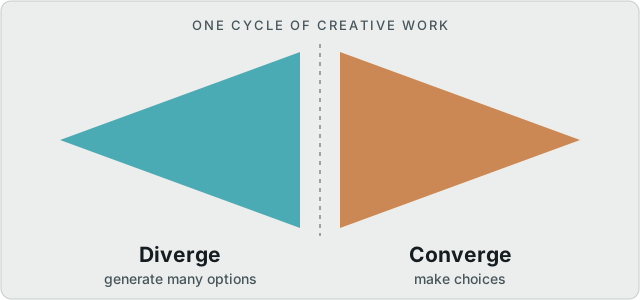
- Divergence — generating many options before judging any of them.
- Convergence — choosing well, without crushing what was just created.
The process: four stages, and a centre
The diverge–converge heartbeat repeats through four stages of work — Clarify → Ideate → Develop → Implement — with one habit at the centre: assessing the situation, the pause between stages where a group takes stock and chooses where to go next. Samvinas's tool picker is organised around the same stages.
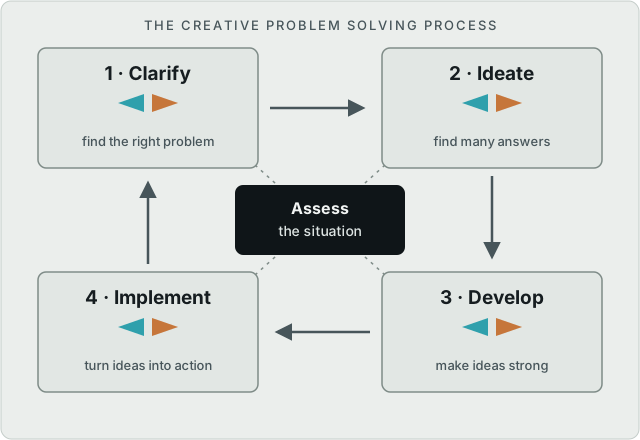
- The four stages — what each stage is for, what "done" looks like in each, and the assessing habit at the centre.
- The process at a glance — all six steps side by side, each with a starting condition, so you can tell where your work should enter the process.
Two habits that make it work
- Deferring judgement — why evaluation is postponed, not abandoned, and what that does to a group.
- Framing problems as questions — turning verdicts into invitations: "How might we…?"
Lineage
None of this is our invention. CPS began in the 1950s with Alex Osborn — the adman who coined "brainstorming" — and Sid Parnes, and it has been refined by seventy years of practitioners and researchers since: Ruth Noller, Roger Firestien, and Gerard Puccio, Marie Mance and Mary Murdock, among many others. These pages paraphrase that shared tradition; the tools in Samvinas are built to run it.
Running an event? The facilitator guide shows which tools support each move.